Volunteer coaches are often handed a stack of plays and a week to teach them. I stopped doing that a long time ago. Young players forget a playbook as soon as the game speeds up. What they can learn, and repeat, is one pattern: pass, cut, and fill the open space. From 2001 to 2013 I ran youth basketball leagues for about 800 kids a year. The offense below is the one I trusted with mixed-ability teams, from the early grades through high school, with the details adjusted for age.
This guide is for volunteer coaches. It works alongside the habits in How to Teach Team Play. Follow your league’s rules if they limit presses, zones, or how you inbound the ball.
Why one pattern beats a playbook
A play with four options looks clean on a whiteboard and falls apart on a Saturday morning. Someone forgets the second cut. Someone else holds the ball. The rest of the team watches. One pattern, taught until it is automatic, gives every child a job they can do without a reminder from the bench.
The first lesson is spacing, not scoring. If five children stand in a tight cluster, even a good pass has nowhere to go. If they occupy five spots, a pass and a cut have a purpose. That is true whether the team is ahead or behind.
Five spots, not five plays
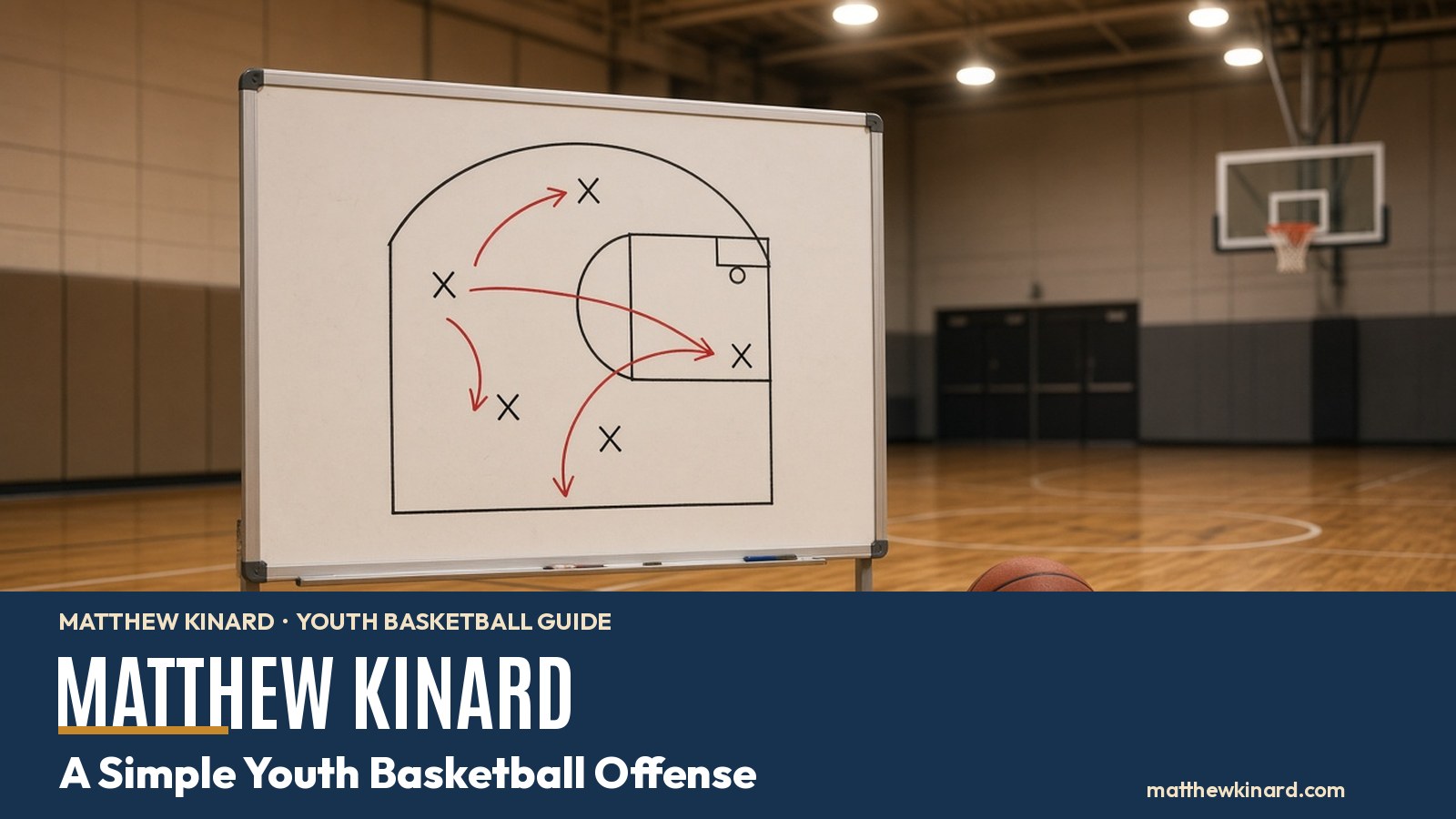
I taught a simple five-out spacing for most youth teams: one player at the point, one on each wing, and one in each corner. No one starts in the lane. For older groups, a 4-out look with one player near the basket can work if you have a child who can occupy that space without clogging it. For everyone else, five spots on the perimeter is clearer.
The rule is simple. If a spot is empty, fill it. If you have the ball, you are not looking for a clever play call. You are looking for a teammate, then for the cut, then for the next pass.

The only pattern: pass, cut, fill
Here is the whole offense, in three steps:
- Pass to a teammate who is in a spot.
- Cut to the basket. The passer does not stand and watch.
- Fill an open spot if you do not get the ball, and have the next player fill the spot you left.
That is enough. The cutter looks for a return pass. If it is not there, they clear through and take an empty corner or wing. The teammate who was on the weak side slides up to the open spot, often the point. The ball can then be reversed and the pattern starts again.

What to do when you have the ball
Catch the ball, get your feet set, and look inside first. The cutter may be open for a moment. If not, look to the next pass. A dribble is a tool, not the first option. One or two dribbles to improve an angle, to escape a close defender, or to get the ball across half-court are fine. A long dribble into a crowd is how possessions stall.
- Cue: “Catch. Look inside. Then pass or attack.”
- Cue: “Do not watch your own pass.” The cut starts as the ball leaves the hands.
- Common fault: Holding the ball at the point until a coach yells. Put a short count on it in practice: catch, look, pass or drive, then cut.
How to teach it in practice
Walk it through 5-on-0, slowly, until the spots and the cuts are familiar. Then go 3-on-0 on one side of the floor: pass, cut, fill, and finish or kick out. After that, play 3-on-3 and 5-on-5 with one rule: if the spacing collapses, you freeze the possession and reset the spots. Keep the freezes short. The point is a quick picture, not a lecture.
I liked to start the pattern from a wing pass as often as from the point, so the same two or three children were not the only ones bringing the ball up. The practice plans have a scrimmage segment where this work belongs. The passing and spacing habits in How to Teach Team Play are the foundation. The finishing work in Teaching Shooting Form to Young Players gives the cutter something to do if the pass arrives.
What to teach at each age
| Age group | Focus | Leave for later |
|---|---|---|
| Kindergarten to 2nd grade | Find a spot, pass to a teammate, take a few steps toward the basket after you pass. | A full five-spot pattern, weak-side filling, set plays. |
| 3rd to 5th grade | Five spots, pass-cut-fill, looking inside to the cutter, reversing the ball. | A playbook with options for every catch. |
| 6th to 8th grade | The same pattern at game speed, filling from the weak side, a simple way to start after a rebound or inbound. | New plays installed in a timeout. |
| High school | The pattern against pressure, using a dribble to improve an angle, keeping spacing late in a game. | A crowded playbook that hides the cutter. |
Against pressure
Do not install a five-option press break for a youth team that is still learning to pass and cut. Catch the ball, pivot, and meet a pass rather than waiting for it. Have a safety behind the ball. If your league allows a full-court press, spend a few minutes of practice inbound and advancing the ball with those same habits, not with a new system.
When the defense extends, the cut still matters. A child who catches and holds is easier to trap. A child who catches, looks, and moves the ball gives the next teammate a chance.
Common problems and simple fixes
- Everyone stands and watches the ball. Freeze, point at the empty spots, and restart. Praise the child who filled a spot without the ball.
- Cuts that stop in the lane. The cutter has two jobs: look for the pass, then clear through. A traffic jam in the paint is a spacing problem, not a hustle problem.
- The same child always brings the ball up. Start possessions from a wing or a different inbounder in practice. Every child should get the chance to make the first pass.
- Too much coaching from the sideline. Call the pattern in practice. In a game, a short reminder is enough. A child who is listening for the next instruction cannot see the cut.
You do not need a clever playbook to run a youth offense. You need five spots, one pattern, and an adult who notices the pass and the cut, not only the shot. A child who can pass, cut, and fill has a job on every possession, whether or not their name is in the scorebook.
Use this pattern in the scrimmage segment of the practice plans, and pair it with the defensive habits in Teaching Defense to Young Players. I am Matthew Kinard. More of my writing and background is on my main site, mattkinard.com, including the essay Youth Basketball Coaching Tips From Matt Kinard.