Young players do not become a team by memorizing a playbook. They become a team when they can share the ball, leave room for a teammate, and know what to do for the two seconds after they pass. That is the work I care about in this guide. It comes from years of watching new coaches try to install a full half-court set with children who were still learning to catch the ball in a crowd.
Teach one habit at a time. Use a smaller game than 5-on-5 until that habit shows up without you stopping play every trip.
Start smaller than a full team
2-on-1 is the most useful teaching game I know for beginners. Two offensive players start at half court. One defender waits near the basket. The offense must make at least one pass before a shot. If they score, they stay on offense. If they do not, the defender rotates out and a new defender steps in.
What it teaches, quickly:
- The extra player should pass, not crowd the ball.
- The teammate without the ball has to move to a new spot.
- The defender has to decide whom to stop, which is the beginning of help.
When 2-on-1 looks clean, add 3-on-2. Same rule: at least one pass, no charging into a teammate’s space. Only then should you spend a long stretch in 5-on-5.
Spacing in language kids can use
Do not start with a lecture about lanes and angles. Use floor marks they can see. The painted circles, free-throw dots, and sidelines are already there. Try these three rules:
- If you do not have the ball, do not stand in the same small circle as the teammate who does.
- If you pass, take two steps away from the ball or toward the basket. Standing still after a pass is how piles start.
- If you are in a corner or on a wing, keep one foot near a line so you can find your spot again after a scramble.
When two children occupy the same space, freeze the play, walk them to their spots, and restart from there. You will do this often in the first weeks. That is normal.
Pass, then cut
This is the one team habit I would install before any designed play. After a pass, the passer walks, then jogs, through an open space toward the basket or toward a new spot on the perimeter. The new ball handler looks there first.
Teach it in this order:
- Walkthrough, no defense, five times from each side.
- Jog through with a coach as a dummy defender.
- Live in 3-on-3, with a constraint: a basket counts only if a cut happened on that trip.
You are not hunting for fancy back cuts. You are teaching the idea that the pass is the start of the action, not the end of it.
Give people work that is not scoring
If the only praise in practice is for a made shot, the rest of the work disappears. Assign visible jobs that help the group function:
- First person back after a change of possession.
- The inbounder, who has to find a teammate and make a clean pass.
- The rebounder who turns and looks up the floor before dribbling.
Name the job, then notice it out loud when it happens. The child who rarely scores still has a way to help the team on the next trip. That is not a consolation prize. It is how a group starts to depend on more than one person.
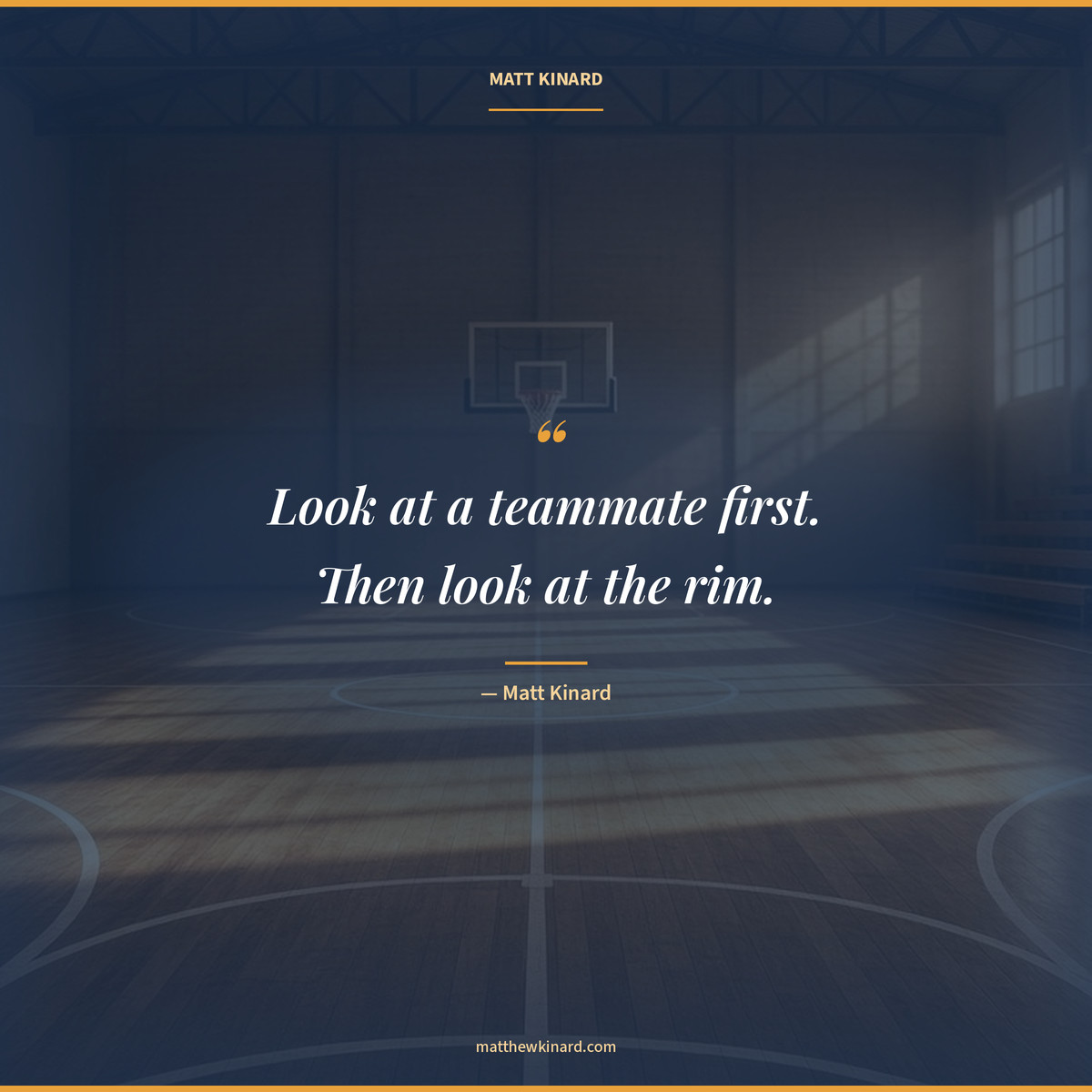
Keep your vocabulary short. I like three phrases: “Find a new spot,” “Look at your teammate first,” and “Go again.” If you introduce a new phrase, retire an old one for a week so the gym does not fill with noise.
A weekly habit calendar
| Week | Habit | How you will know it stuck |
|---|---|---|
| 1 | Catch, hold, then decide | Fewer panicked dribbles the moment the ball arrives. |
| 2 | Pass and take two steps | Fewer players standing still after they pass. |
| 3 | 2-on-1 with one required pass | The extra player looks to pass more often than to crowd the rim. |
| 4 | Outlet or inbound to a target | The first pass after a stop is intended, not thrown away. |
| 5 | Help the teammate who just picked up the ball | Someone moves to a passing window instead of watching. |
Drop these habits into the scrimmage segment of the practice plans. When a habit is new, shrink the game. When it is familiar, let 5-on-5 run and stop only when the habit disappears for two or three trips in a row.
A related YouTube Short: Matt Kinard: Teaching kids to make the extra pass.